
Routing #303986313

Think your account or information may be compromised?

Follow these steps to help protect your accounts and limit potential damage.

Step 1: Contact TTCU immediately

Step 2: Lock your cards

If you're unable to reach us, use the mobile app or online banking to lock your cards

  • Mobile app
    • Log in and tap Cards on the bottom toolbar
    • Choose the card you need to lock
    • Find the Lock this card toggle and turn it on
  • Online banking
    • Find Online Banking in the top toolbar of the TTCU.com website
    • Log in and hover over Card Management in the top toolbar
    • Choose Manage cards
    • Choose the card you need to lock (verify the last four digits)
    • Find the Lock this card toggle and turn it on

Step 3: Place a fraud alert

Contact one of the three major credit bureaus:

Step 4: Report identity theft


Protect yourself from fraud and identity theft

Learn how to protect your accounts and personal information from fraud and identity theft.

Avoid phishing and fraud scams
  • Be cautious of emails or messages that create urgency or ask for personal information
  • Do not click links in unexpected emails or texts
  • Verify the sender by contacting the company directly
  • Be aware of phone scams asking for account details
Protect your accounts and personal information
  • Use strong, unique passwords for each account
  • Keep your devices, browser and software up to date
  • Avoid using public or unsecured Wi-Fi for financial activity
  • Protect personal information shared online and on social media
Protect your cards and payments from fraud and theft
  • Monitor your account activity regularly
  • Keep checks and financial documents secure
  • Shred sensitive documents before disposing of them
  • Complete checks fully to prevent alteration
  • Use a gel pen to reduce risk of check washing
  • Take outgoing mail directly to the post office when possible
Use TTCU tools to monitor and protect your accounts
  • TTCU uses transaction monitoring to detect unusual activity
  • You may be contacted if suspicious activity is identified
  • Always verify by contacting TTCU using a trusted phone number - (918) 749-8828 or (800) 234-8828
  • Keep your contact information up to date so alerts can reach you
  • Use digital banking tools to review activity and manage your accounts

Spot fraud and verify suspicious activity

Learn how to recognize common scams and verify when something doesn't seem right.

Recognize phishing, scam messages and fraud attempts
  • Messages may create urgency or pressure you to act quickly
  • Links or websites may appear legitimate but are not
  • Emails or texts may contain spelling or grammar issues
  • Requests for personal or financial information are a warning sign
Verify calls, texts or emails claiming to be from TTCU
  • TTCU may contact you if suspicious activity is detected on your account
  • Always verify by contacting TTCU using a trusted phone number - (918) 749-8828 or (800) 234-8828
  • Do not provide sensitive information unless you initiated contact
  • Be cautious of calls or texts asking you to confirm account details
Monitor your accounts for unusual activity
  • Review your account transactions regularly
  • Look for charges or activity you don’t recognize
  • Watch for missing statements or unexpected account changes
  • Keep your contact information up to date to receive alerts
Know common warning signs of identity theft
  • Unexpected credit or account activity
  • Denial of credit without clear reason
  • Unfamiliar accounts on your credit report
  • Communications about accounts you did not open

How TTCU helps protect your accounts

We use tools, monitoring and ongoing employee training to help keep your information and accounts secure.

Fraud monitoring

  • TTCU uses transaction monitoring to detect unusual activity on your accounts
  • We may contact you if suspicious activity is identified

Account alerts and controls

  • Receive alerts when certain account activity occurs
  • Use digital banking tools to monitor transactions and manage your accounts
  • Lock or unlock your card if it is lost or misplaced

Ongoing employee training

  • TTCU employees complete ongoing training to recognize fraud and scam activity
  • This training helps our team identify threats and support members more effectively

What TTCU will never do

  • Ask for your online banking password
  • Request one-time security codes
  • Ask for your full card number or PIN
  • Pressure you to act immediately or move money to another account

Stay informed about scams and fraud

Learn about current scams and how to protect yourself with the latest fraud and security tips.

Barcode Bonanza

| Josh O.

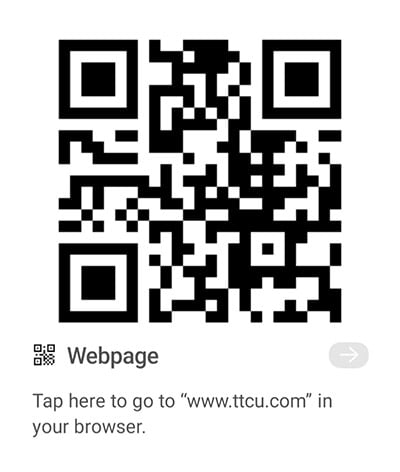
QR Code linking to ttcu.com

Why are there funny looking barcodes everywhere?

Even if you're not familiar with QR codes, you're seeing them everywhere - in print, on TV and at the store. The "QR" stands for "quick response," which is exactly what they're designed to do. These funky looking barcodes (usually a square image with small black and white shapes) store information that can quickly be read by your mobile phone's camera*. Normally, the barcode will take you to a website to view information about a place you are visiting or a product you are interested in.

Even more functions have been added to QR codes. Today, they can:

  • pop-up text on your mobile-device screen when you scan it
  • bring up an email for you to send to a specific address
  • bring up your phone app to dial a number
  • pop up your text app so that you can send a text somewhere
  • pull up your maps app to see where you are or to get somewhere else
  • pull up a social media page or channel
  • join a local Wi-Fi network
  • pull up a crypto address to make a payment
  • display a PDF file or picture
  • take you to a mobile app store to download an app

Unfortunately, any time a new convenience comes along, criminals look for ways to gain something from that technology. Criminals have started to use QR codes for malicious activities, like taking you to a fake website, installing a corrupt app on your phone or to collect your personal information. Another problem is that QR codes are free to create and there are many ways to create them.

QR codes are becoming more common in restaurants to see the menu, in stores to learn more about a product and at an attraction to navigate you through the areas. These are all places for criminals to stick their own QR code on top of the legitimate QR code. When you scan the code, your mobile device starts you down a malicious path even though you believe it was legitimate scan.

As you can see with the QR code above, when you scan it, your device should pop up a preview telling you where the code will be taking you if you choose to continue. This is the equivalent of hovering your computer mouse over a link to see if you want to go to a website before you click. This is an important safety precaution and reminder to be aware of where QR codes are taking you. If you don’t feel good about the website name before or after you visit it after scanning a QR code, just close your camera app or the browser window it took you to.

Some additional tips for QR code safety:

  • look to see if the QR code has been tampered with, like a new code sticker on top of the original
  • use the built-in camera app on your mobile device to scan QR codes
  • be cautious when logging into a site after scanning a QR code
  • don’t download an app from a QR code
  • don’t make a payment from a QR code

* Message and data fees may apply from your wireless carrier.


The information on this page is provided solely for general informational and educational purposes and does not constitute legal, tax, financial, or cybersecurity advice. While TTCU strives to provide accurate and timely information, fraud trends, privacy risks, and security threats may change over time, and TTCU does not guarantee that the information presented will prevent all fraud, identity theft, or unauthorized account activity. Members should contact TTCU promptly regarding specific account concerns, suspected fraud, or security incidents.